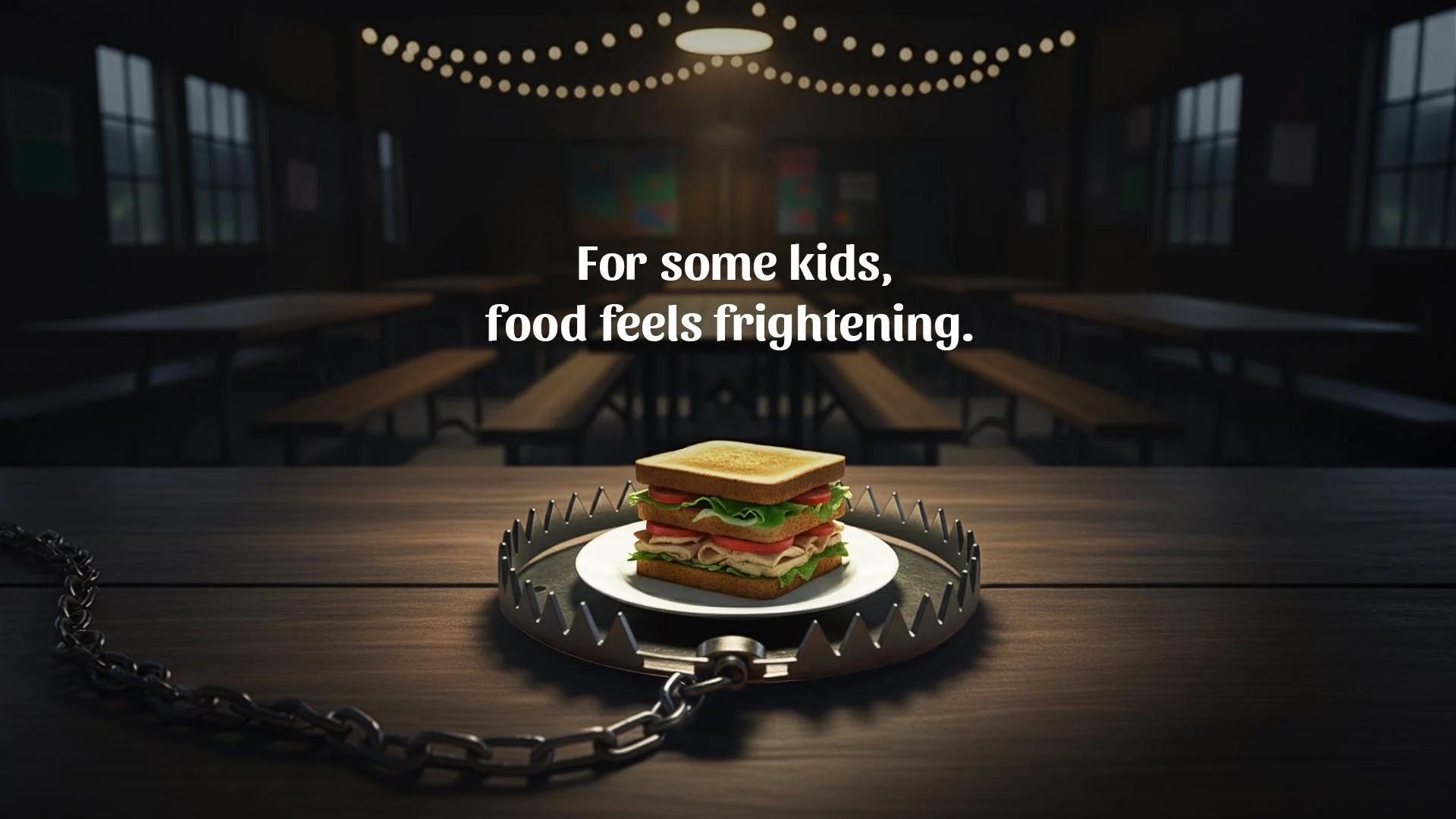
But the real danger is silence.
When a child or teen restricts eating, fixates on “good” or “bad” foods, or seems anxious at mealtimes, it’s probably not just picky eating. It’s likely fear of judgement or not “measuring up”.
For some, that fear gathers speed like something chasing them in the dark, until food becomes the only thing they can control to keep the chaos from closing in.
The risks of misunderstanding this monster range from self-harm, cardiac arrest, or suicide.
Too many children & youth suffer quietly because adults mistake their distress for something else.
One in four 12-to-25-year-olds are impacted by an eating disorder.
Yet most people are unaware that when a young person starts using food control to cope with distress, it’s not vanity or stubbornness.
It’s likely survival from brain pain. The majority of all mental illnesses start in childhood. EATING DISORDERS are the deadliest mental illness after opioid addiction.
The mortality rate for having an eating disorder is estimated as high as 15%. Early recognition can save a life. Prevention would be even better.
See What You Can Do
-
![Parents and Guardians]()
Parents & Guardians
Ask your school’s PAC Chair, or take the lead and gather any parenting community to sign-up for our Beyond Body Talk program for parents and learn how to recognize the early warning signs.
-
![Donors & Sponsors]()
Donors & Sponsors
Your support funds awareness through parent outreach and affordable (ideally FREE) workshops, designed to help families respond with empathy, not panic. We believe prevention is possible.
-
![Educators & PAC Chairs]()
Educators & PAC Chairs
Parent Advisory Councils & Principals: invite Reframe Voices to deliver a 10-min. pitch or simply book a Beyond Body Talk, presentation or workshop, to advocate for community education.



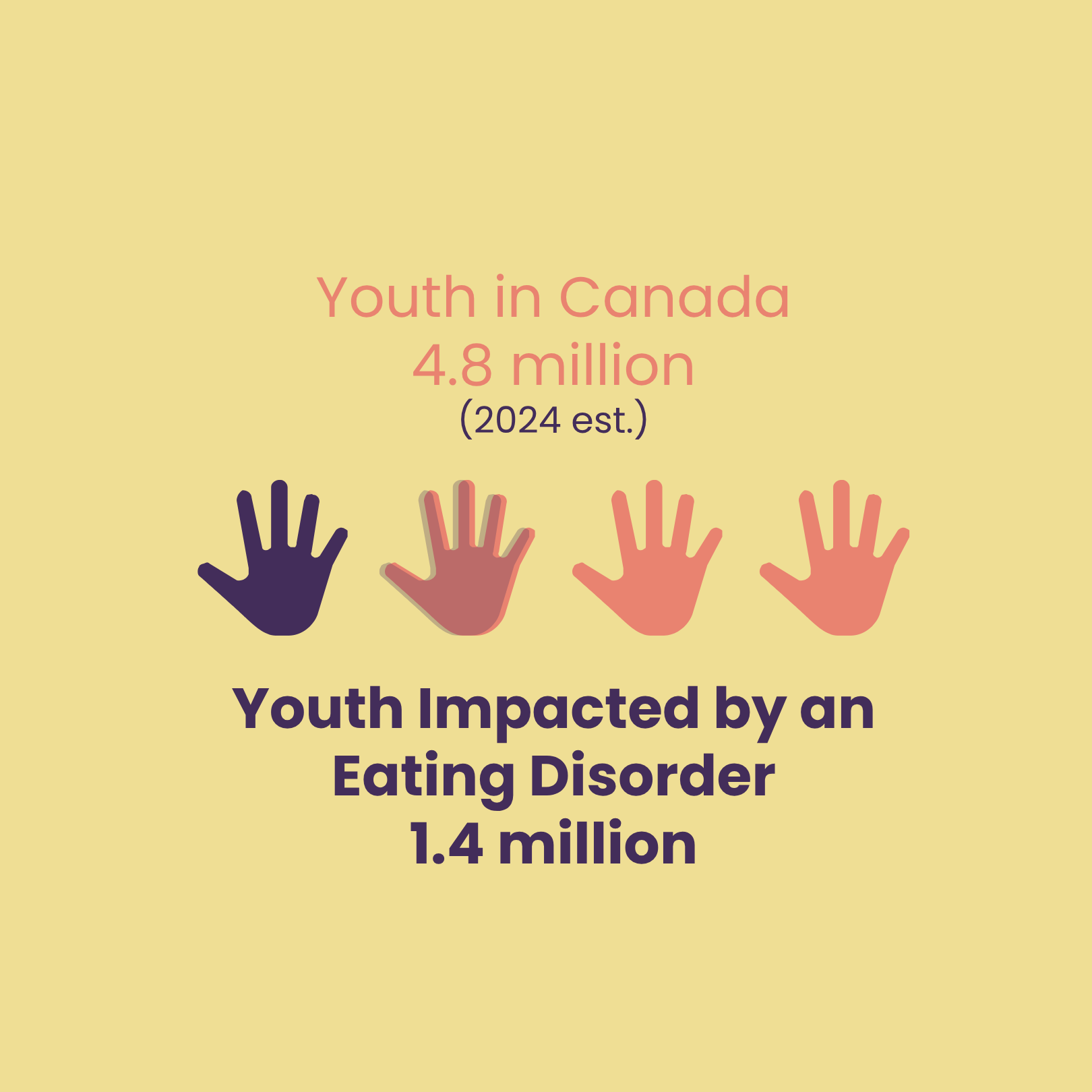
Nearly 1 in 4 Canadian adolescents (12-25) struggle with an Eating Disorder.
An estimated 1.4 million Canadians aged 12–25 (out of 4.8 million youth as of 2024) are living with an eating disorder. At least 1 in 8 adolescents are considered “at risk” of developing one.
There is no single cause behind eating disorders which is why they are called “complex” illnesses. For each child or adolescent, vulnerability develops through a mix of biological, psychological, and social influences. These factors can overlap and interact in ways that make some more "at risk than others.
Despite serious health complications, it’s estimated that less than 25% of young people living with an eating disorder seek treatment. Meanwhile, the mortality rate associated with Anorexia alone is 12X greater than all other diseases for females 15-24 years-old.
British Columbia has one of the highest reported incidences of eating disorders hospitalizations in Canada next to Ontario.

To educate parents, guardians, and educators on how to recognize the early signs of eating disorders.
To teach them how to gently disrupt harmful patterns of disordered eating in kids, through understanding and trust so kids feel safe expressing their feelings about this complex mental health issue.
Our ultimate mission is to prevent the spiral into silence and shame before a mental health crisis takes hold.
Our Mission
More than 75% of eating disorders start in childhood. Since the pandemic hospitalizations have soared. Kids as young as pre-puberty are being diagnosed. And yet…
In Canada, prevention of eating disorders is still underfunded and overlooked. Programs focused on other health issues, like obesity, often get priority, even though weight-focused messaging can unintentionally fuel the very illnesses we should be preventing. (Canadian Eating Disorders Strategy, 2019–2029)
Kids are bombarded with weight-loss messages from media, influencers, even family. Too many will struggle in silence because they don’t look sick.
Learn to notice before unhealthy patterns and behaviours get hardwired in.
The weight of growing up in a biased culture.
When The Warning Signs Are Missed
-
Viktoria (27, recovered)
“When I was 15, my parent’s concern about my weight often showed up as painful comments. What I really needed was compassion, but all I felt was shame and loneliness. Then restrictive dieting took over my life and I starved myself, believing that being thin would make me feel like ‘enough’.
If you’re a parent, please know that your words matter… more than you might realize.”
-
Mother (of youth in recovery)
“What started out as healthy choices and fitness goals changed quietly and unsuspectingly into punishment, withholding and starvation.
Watching her struggle, waste away and become fearful of food - something that used to bring us together to be social and celebrate soon brought her anxiety and sadness. Learning to walk a delicate tightrope everyday and find the tools to help someone learn to love themselves again - once it begins it may truly never end.” -
Make Prevention a Priority
“As a local family physician of 20 years, I see far too often the despair in finding resources for families and youth with body image and mental health disorders. Children and youth with eating disorders need us to listen, to make proactive, preventative care a priority, and to provide families with the support they deserve for this deadly illness.”
Dr. Maryam Zeineddin, MD, CCFP, FCFP, and past President of BC Family Doctors
Educators:
Explore the workshop.
Want your staff and parent community to feel prepared to recognize disordered eating early? Beyond Body Talk gives adults practical tools and language to open up conversations with confidence.
👉 Share with your PAC or book a workshop for your school’s parenting community to build on the PARENT/TEACHER/STUDENT triad, and foster a culture of care.
“As you know, eating disorders are on the rise and the Internet is not helping matters for this generation of children and youth. Congratulations on launching this initiative.”
Donors:
Be part of a child’s safety net.
Early parenting education on this subject can save a lifetime of struggle. It could even save a life.
Our Resources
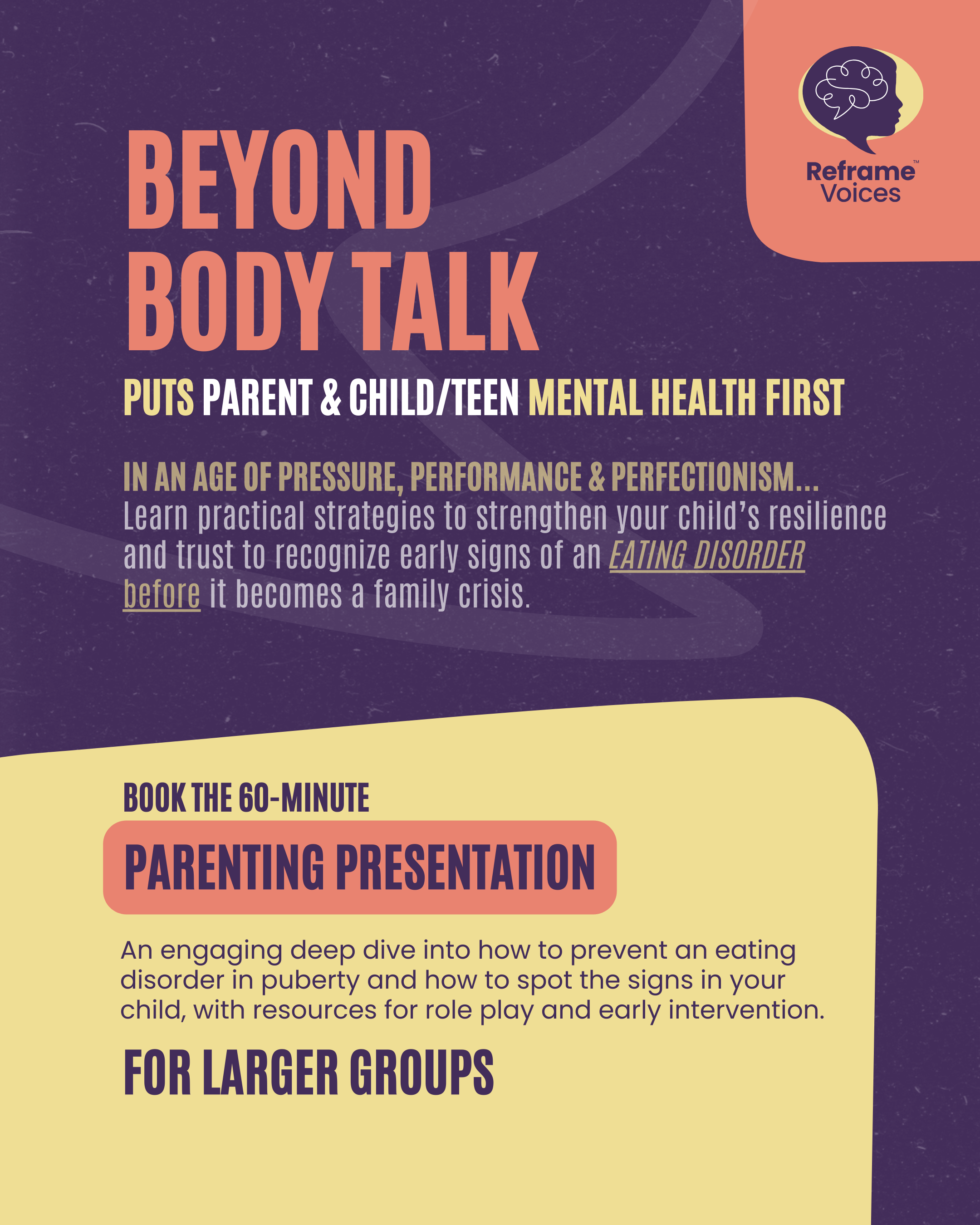
WE BELIEVE EATING DISORDERS PREVENTION IS POSSIBLE, THROUGH PARENTS. ONE SCHOOL COMMUNITY AT A TIME.
In an era when body-shaming and bullying is at an all time high, Beyond Body Talk is personally delivered and deliberately designed to bring parent communities together in one room, to learn more about how to:
Understand early signs of body image and mental health struggles
Learn stigma-free, practical strategies to support prevention
Ideal for inclusion within an existing PAC meeting, and created as a modified version of the workshop, the presentation is designed to reach LARGER AUDIENCES, who may learn to:
Confidently start sensitive conversations with adult family members about prevention
Have age-appropriate conversations around your kids (pre-puberty or during adolescence) about topics not addressed by school curriculum
✔ FOR GROUPS* of 25 to 100
EXPERIENCE an engaging, in-person talk, with room for Q&A at the end.
LEARN what to say so your kids don’t shut you out.
INCLUDES optional ‘take-home’ package for ongoing active practice.
AVG. COST PER PERSON ranges $25 to $30* depending on group size. Consult your PAC for subsidization to reduce the cost per household investment, or ASK US ABOUT Corporate Sponsorship Opportunities.
LOCATION - Typically hosted in your school’s auditorium.
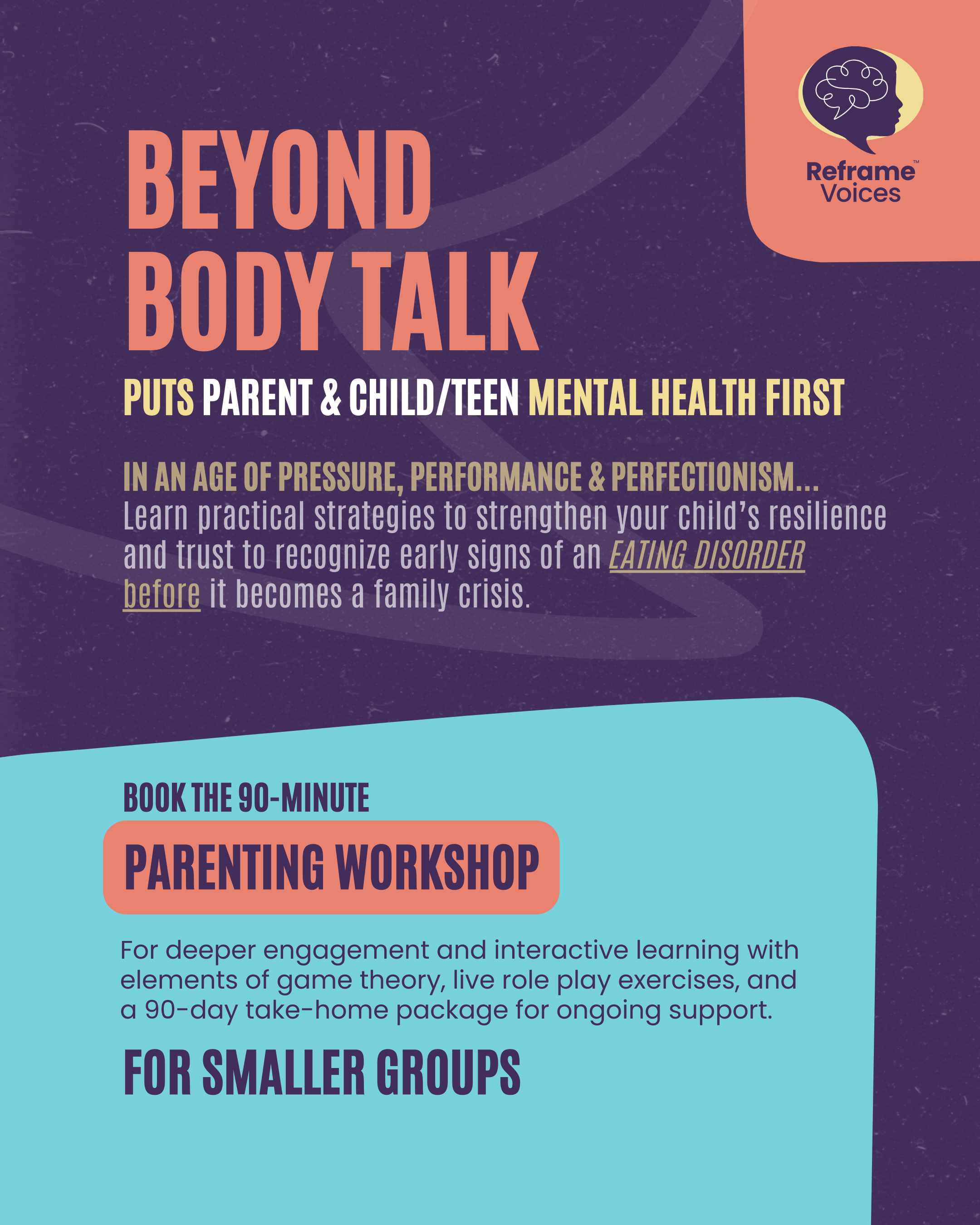
WE BELIEVE EATING DISORDERS PREVENTION IS POSSIBLE, THROUGH PARENTS. ONE SCHOOL COMMUNITY AT A TIME.
In an era when body-shaming and bullying is at an all time high, Beyond Body Talk is personally delivered and deliberately designed to bring parent communities together in one room, to learn more about how to:
Understand early signs of body image and mental health struggles
Learn stigma-free, practical strategies to support prevention
In an interactive setting for SMALL-GROUP discussions and deeper engagement, learn to:
Confidently start sensitive conversations with adult family members about prevention
Have age-appropriate conversations around your kids (pre-puberty or during adolescence) about topics not addressed by school curriculum
✔ FOR GROUPS* of 20 to 24
EXPERIENCE a hands-on group discussion with engaging elements of role play, game theory and core values review.
LEARN what to say so your kids don’t shut you out.
INCLUDES optional ‘take-home’ package for ongoing active practice.
AVG. COST PER PERSON is $52 depending on group size. Consult your PAC for subsidization to reduce the cost per household investment, or ASK US ABOUT Corporate Sponsorship Opportunities.
LOCATION - Typically hosted in your school’s library.

As seen & heard in the media



Founding Corporate Sponsors